 how-to
How to Choose a Haircut for Fine Wavy Hair
Last Updated: October 25, 2026
Quick Summary
To choose a haircut for fine wavy hair, match the shape to your wave pattern, keep weight where you need it, and remove bulk only where waves clump. The collarbone cut with long layers starting below the chin is the sweet spot for most fine wavy hair. Low-density hair often does better with a strong perimeter than heavy layers.
- Wash, skip product and air dry to read your wave pattern before choosing a cut.
- Density drives the cut more than wave type: low density needs fewer layers.
- Ask for a dry cut or a dry check so shrinkage does not shorten the shape.
- Refuse thinning shears and heavy razor work, which remove coverage fine hair cannot spare.
- Trim a graduated bob every 6 to 8 weeks and a one-length lob every 10 to 12 weeks.
Table of Contents
- Start With Your Wave Pattern and Hair Density
- The Best Haircuts for Fine Wavy Hair, Ranked by Length
- Layers for Fine Wavy Hair: Where They Help and Where They Hurt
- One-Length Cuts, Bangs, and Fringe Options
- How to Ask for a Haircut for Thin Wavy Hair
- Low-Maintenance Hairstyles for Wavy Hair That Still Look Polished
- Book a Consultation at Sunbeam Hair Studio
- Frequently Asked Questions
Start With Your Wave Pattern and Hair Density
Choosing a haircut for fine wavy hair starts with two facts about your own head: how your waves form and how much hair you actually have. At Sunbeam Hair Studio, we encourage clients to look at their hair first. Most disappointing cuts trace back to a mismatch between the cut and the hair's natural pattern.
Fine wavy hair is hair with a loose bend or S-curve, small strand diameter, and fewer hairs per square inch than average. That combination changes everything about how a cut behaves.
Here is the short version of how to choose a haircut for fine wavy hair: match the shape to your wave pattern, keep weight where you need it, and remove bulk only where waves clump.
Reading Your Wave Pattern: Loose Waves vs. Defined S-Waves
Wash your hair, skip product, and let it air dry. Then look at the shape.
- Loose waves bend gently and fall closer to straight at the root. They need shape cut in, or they collapse into flatness.
- Defined S-waves form a clear curve through the mid-lengths. They hold shape well but bunch up when cut too short.
- Mixed patterns wave more on one side or at the back. Cut to the stronger pattern, not the weaker one.
A common mistake is judging pattern on day-two hair. Second-day waves stretch out, so you under-cut the shape you actually need.
Why Density Changes the Cut More Than Texture Does
Density is how many hairs sit on your scalp, and it drives the cut more than wave type does. Low-density fine hair shows scalp at the part and thins at the ends. Layering aggressively there removes the coverage you have.
Higher-density fine wavy hair can carry more layers because there is hair to spare. The wave pattern decides where layers go. Density decides how many.
The Best Haircuts for Fine Wavy Hair, Ranked by Length
The best haircuts for fine wavy hair share one trait: they concentrate weight where it reads as fullness. Length changes which shape does that best.
| Length | Best Cut | Works Best For | Main Trade-Off |
|---|---|---|---|
| Short | Graduated bob or soft pixie | Low density, strong wave | Needs frequent trims |
| Medium | Collarbone cut with long layers | Most fine wavy hair | Can flatten at the crown |
| Long | One-length with face framing | High density, loose waves | Weight pulls out wave |
Bobs, Graduated Bobs, and Pixie Cuts
A bob is the safest short option for fine wavy hair. A graduated bob builds weight at the back, which creates the illusion of thickness. Keep the perimeter soft rather than razor-sharp so waves can move.
Pixie cuts suit defined waves and strong density. On loose waves they often fall flat within a day.
Collarbone and Medium-Length Cuts
The collarbone cut is the sweet spot for most fine wavy hair. It keeps enough length for waves to form and enough weight for the hair to look full. Ask for long layers starting below the chin, not at the crown.
Long Hair, Shags, and Wolf Cuts
Long hair works when density is average or higher. Past a certain length, weight drags loose waves straight, so have your stylist check the shape dry before committing.
Shags and wolf cuts add movement and suit defined waves. On low-density fine hair, heavy texturizing in a shag can thin the ends too much.
Layers for Fine Wavy Hair: Where They Help and Where They Hurt
Layers for fine wavy hair help when they sit where the wave bends. They hurt when they start too high and strip weight from the crown.
Where layers help:
- Below the chin, to release wave and add movement
- Around the face, to soften the shape
- At the ends, to stop a heavy line
Where layers hurt:
- At the crown, which flattens the top
- Cut too short, which creates frizz instead of wave
- Too many at once, which thins the perimeter
Here is the contrarian part. Not every fine wavy head needs layers. A blunt, one-length cut can create the illusion of thickness, and too many layers can make fine hair look thin and wispy.
One-Length Cuts, Bangs, and Fringe Options
One-length cuts give fine wavy hair a solid baseline. The perimeter stays full, waves clump at the ends, and grow-out is simple. The trade-off is less movement through the mid-lengths.
Bangs need care on fine wavy hair. Wavy fringe shrinks up when it dries, so ask for bangs cut slightly longer than you want them.
- Curtain bangs: the most forgiving option, blending into face-framing layers
- Soft blunt fringe: works on higher density, needs daily styling
- Side-swept fringe: low upkeep, good for loose waves
How to Ask for a Haircut for Thin Wavy Hair
Knowing how to ask for a haircut for thin wavy hair matters as much as the cut itself.
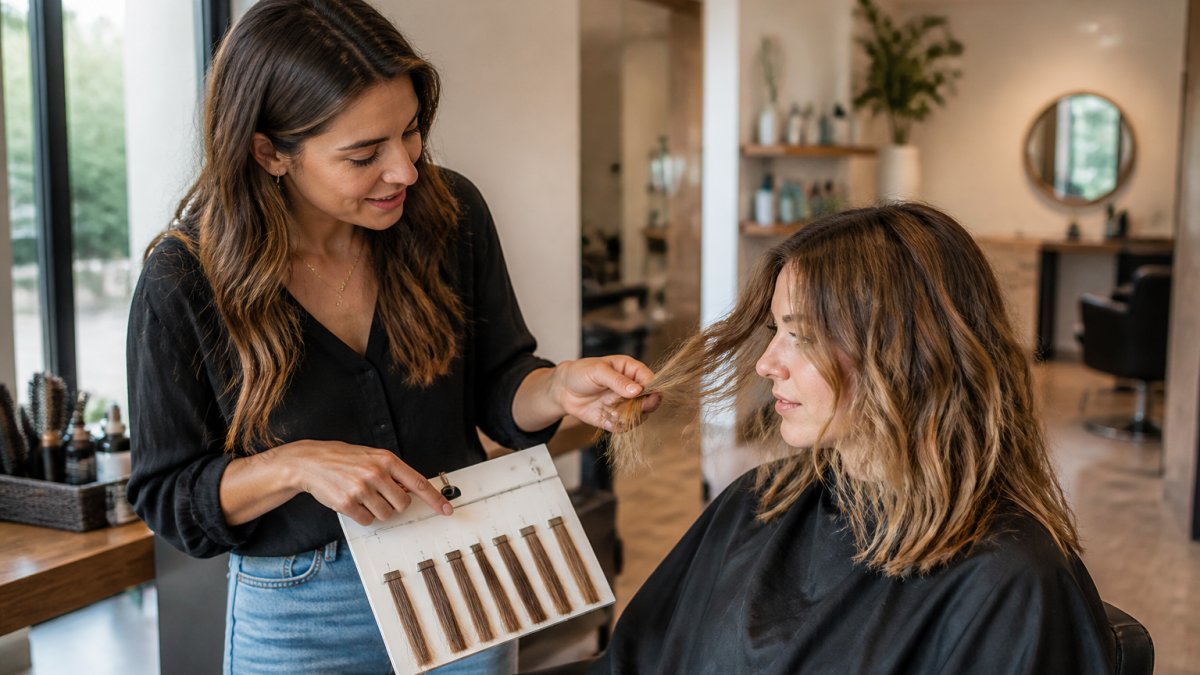
The consultation script below covers the four decisions a stylist has to make, perimeter, layer placement, cutting method, and finishing technique. Read it before you sit down, then adjust the specifics to your wave pattern and density.
"My hair is fine and wavy. I want to keep weight at the perimeter and add long layers that start below the chin, not at the crown.
That script does four jobs at once. It names your texture, protects the perimeter, asks for a wave-aware method, and rules out the techniques most likely to backfire.
The techniques to name, and the ones to refuse
Fine wavy hair responds differently to each cutting method, and the difference shows up most at the ends.
- Blunt or one-length cuts: keep the perimeter solid and make hair read fuller. Good default for low density. The trade-off is less movement through the mid-lengths.
- Point-cutting: removes small notches at the ends and softens a line. Fine in small amounts at the very ends; too much creates a wispy, see-through perimeter.
- Razor cutting: creates movement and a lived-in finish on medium and coarse hair. On fine hair it can carve away bulk and leave ends looking stringy, especially when used through the last several inches.
A useful rule: the finer your strands and the lower your density, the less you want any technique that removes hair rather than shapes it.
Why a dry cut or curl-aware method matters
Wavy hair shrinks as it dries. A cut that looks right on wet, combed-straight hair can spring up an inch or more once the wave forms, which is how bangs end up too short and layers end up sitting higher than planned.
Not every wavy texture needs a fully dry cut. A common pattern is to cut the baseline wet for control, then refine the perimeter and layers dry so the wave pattern guides the final shape.
Seeing who specializes in wavy and fine hair helps you request the right person. You can meet the Sunbeam team before you book. You can meet the Sunbeam team before you book.
Low-Maintenance Hairstyles for Wavy Hair That Still Look Polished
Low-maintenance hairstyles for wavy hair work when the cut does most of the styling. A good shape air-dries into place with a light product and a little scrunching. The catch is that "low-maintenance" means different things at different lengths, and the trim schedule matters as much as the cut itself.
What each cut actually asks of you
- Air-dried collarbone cut: light cream, scrunch, go. Refresh day-two waves with a mist of water and a pea-sized amount of cream. Trim every 8 to 12 weeks to keep the perimeter from splitting.
- Graduated bob: round brush at the root only. The back builds its own shape, so most days need nothing more than a rough dry and a finger comb. Expect a trim every 6 to 8 weeks because short layers grow out of shape quickly.
- Long layers with curtain bangs: sea salt spray and hands. Curtain bangs need a quick blow-dry on a round brush two or three times a week to keep their bend; the rest of the cut can air-dry. Trim every 8 to 10 weeks, with a bang trim in between.
How each cut grows out
Grow-out is where low-maintenance cuts earn or lose their reputation. A graduated bob looks sharp for about four weeks, then the back starts to lose its shape and the nape line softens.
If you want the longest stretch between appointments, choose a cut with a strong perimeter and minimal layering. If you want movement and are willing to book more often, layers and bangs deliver more shape per wash.
Styling that keeps fine waves from going piecey
Fine wavy hair reads as polished when the ends clump instead of separating. Two habits help: apply product to damp hair and scrunch upward rather than downward, and use less product than you think you need.
The right products make the difference between polished and piecey. You can shop our brands for wave-friendly stylers. For guidance from the American Academy of Dermatology on hair care, gentle handling protects fine strands.
Book a Consultation at Sunbeam Hair Studio
The right cut starts with a real conversation about your hair, not a photo on a phone. We offer in-depth consultations, and our stylists cut with your natural wave in mind. You can review our hair cutting services to see what a visit includes, or contact Sunbeam Hair Studio to schedule your consultation.
Frequently Asked Questions
Do layers look good on fine wavy hair?
Layers can work well on fine wavy hair when they are placed carefully. A few long layers through the mid-lengths and ends remove bulk without stripping density, and they let loose waves spring up instead of hanging flat. The risk is going too short or too numerous with the layers. Heavy layering removes weight near the perimeter and leaves ends looking wispy, which makes fine hair appear thinner. Ask for strategic layers concentrated in the lower half of the hair, and keep the perimeter fuller.
Should fine wavy hair be cut in layers or one length?
It depends on your density and wave pattern. A one-length or blunt cut creates a solid perimeter that reads as thicker, which suits fine hair with loose waves that already have movement. Layers for fine wavy hair help when your waves need encouragement to form and the hair looks heavy or flat at the bottom. Many people do best with a hybrid: a mostly solid shape with a small amount of layering through the ends. A stylist can test both directions during a consultation.
What should I ask for at a haircut appointment if I have fine wavy hair?
Bring photos and describe your routine, not just the look. Tell the stylist how much time you spend styling, whether you air-dry, and where your hair falls flat. Ask for the cut to be done on dry hair in its natural wave pattern so the shape is accurate. Say plainly that you want to avoid excessive thinning or texturizing, and ask how the cut will grow out over the next eight to twelve weeks. That conversation prevents most disappointing results.
What should you avoid when choosing a haircut for fine, thin hair?
Avoid heavy thinning with shears or a razor, especially near the roots and mid-lengths, because it removes the density that makes fine hair look full. Skip very short, choppy layers that leave wispy ends, and be cautious with blunt bangs on low-density hair since they can look sparse. Over-texturizing is another common mistake: point cutting is fine in small amounts, but too much leaves the perimeter stringy. Keep the outline strong and let the wave pattern do the work.
Fine wavy hair rewards precision, and guessing costs you months of grow-out. Let our team map your wave pattern and density before the scissors come out. Get started with Sunbeam Hair Studio and book a consultation for a cut built around your hair.