 how-to
How to Spot Greenwashing in Salons: 7 Steps
Last Updated: October 28, 2026
Quick Summary
Greenwashing in salons happens when a business makes environmental claims it cannot back up, such as using vague words like "eco-friendly" or leafy branding without measurable practices. To spot it, check whether each claim includes specific numbers, a named third-party certifier, and verifiable results before you book.
- Vague terms like eco-friendly or clean carry no defined meaning unless the salon explains them.
- Verify any sustainability certification with the named certifier, not just the logo shown on the website.
- Ask for specifics such as waste diversion rates, water reduction, or dated progress reports before booking.
- Check product ingredient lists against label claims, since a botanical extract alone does not make a product green.
- Ask the salon to describe one operational change from the last year and the result it measured.
Table of Contents
- What Greenwashing Looks Like in a Salon
- Step 1: Build an Eco-Friendly Hair Salon Checklist
- Step 2: Check the Evidence Behind Environmental Claims
- Step 3: Ask the Right Questions Before You Book
- Step 4: Verify Salon Sustainability Certification
- Step 5: Evaluate Green Salon Products
- Step 6: Look Beyond Product Labels to Salon Operations
- Booking a Salon Whose Claims You Can Verify
- Frequently Asked Questions
Plenty of salons now market themselves as "green," but a leafy logo and a few words about natural ingredients don't tell you much. Greenwashing in salons is when a business makes environmental claims it can't back up, and salons are not immune. This guide shows you how to spot it, step by step, so you can tell real sustainability from clever marketing before you book.
What Greenwashing Looks Like in a Salon
Greenwashing is the practice of presenting a business as more environmentally responsible than it really is. In a salon, it usually shows up in the product shelf, the décor, and the website copy.
Researchers have found that people struggle to tell greenwashing apart from genuine claims in advertising (Consumers Struggle to Identify ‘Greenwashing’ in Advertisements).
Vague sustainability terms and buzzwords
Words like "eco-friendly," "green," "natural," and "clean" sound reassuring, but they rarely mean anything specific. A business can call its services eco-friendly without naming a single practice behind the label.
Watch for these red flags:
- Terms with no definition or measurement attached
- Claims like "earth-conscious" with no examples
- Phrases such as "clean beauty" that aren't tied to a standard
Ask one simple question: "What exactly does that mean here?" A business can answer in concrete terms, such as the percentage of waste it diverts or the products it stopped using, which is one way to assess environmental claims.
Nature imagery and green branding
Leaves, sunlight, earth tones, and hand-drawn plants create a calm, green feeling. That look is design, not proof.
Use imagery as a starting point for questions, not as evidence. Check whether the salon backs its visual message with facts you can verify elsewhere on its site or through third parties.
Step 1: Build an Eco-Friendly Hair Salon Checklist
Before you visit or book, write a short checklist. A written list keeps you focused on evidence rather than atmosphere. Your eco-friendly hair salon checklist should cover:
- Certification: Is there a named, third-party sustainability program?
- Waste: Does the salon track foil, color packaging, and water use?
- Products: Can it name the product lines it uses and explain why?
A checklist like this turns a vague feeling into a set of questions you can actually answer.
Step 2: Check the Evidence Behind Environmental Claims
This is where most greenwashing falls apart. Every environmental claim should come with some proof. If a salon says it reduces waste, ask how much and how it measures that.
Look for specifics. A credible claim might sound like: "We divert most of our waste from landfill through a recycling partner and track results monthly." A weak claim sounds like: "We care deeply about the planet."
The Federal Trade Commission (FTC) publishes its Green Guides, which set out how businesses should make environmental marketing claims in the United States (the FTC). You can read the guidance directly on FTC Green Guides on environmental marketing claims.
Quick evidence checks:
- Does the claim include a number, date, or measurement?
- Is there a named partner or program behind it?
- Does the salon explain how it measures results?
Step 3: Ask the Right Questions Before You Book
Asking questions before you book is one of the most useful skills you can build. Most salons will answer honest questions openly.
Good questions to ask a salon about sustainability include:
- Which sustainability certification or program do you participate in?
- How much of your waste do you divert from landfill?
- What do you do with used color foils and packaging?
Pay attention to the tone of the answer. A confident salon will give specifics. A nervous one will repeat the brand story without answering the question.
Step 4: Verify Salon Sustainability Certification
A certification is one of the strongest signals a salon can offer, but only if it's real and relevant. The key is to verify it independently rather than trusting a logo on the website. This section gives you a repeatable method for checking any certification and a standard for the evidence behind it.
Check the certifier, not just the logo
Start by finding the certifying organization. A real certifier has a public website, published standards, and a directory or member list. Search the salon's name on the certifier's site. If the salon does not appear, ask why. Some programs list members only after a review period, but a salon that cannot point you to its listing is a warning sign.
Check the scope of the certification
Certifications vary in what they cover. One program may certify waste diversion only, another may cover energy and water, and another may certify a single product line rather than the whole salon. Ask: what exactly does this certification cover? A salon that says "we're certified" without naming the scope may be overstating what the badge means.
Check the level and validity
Many programs have tiers, such as entry, silver, gold, or leader levels. Ask which level the salon holds and when it was last reviewed. Certifications expire or require renewal, so a badge from several years ago may no longer be current. A credible salon can tell you its level and its most recent review date.
Distinguish independent certification from self-created badges
Some salons display badges they designed themselves, or logos from a supplier's marketing program. These are not independent certifications. A real third-party certifier is separate from the salon and the product brand. If the badge links only to the salon's own website, treat it as a marketing claim, not a certification.
Ask for the evidence behind the claim
Certification is a starting point, not the whole story. Ask for the specific results behind the badge: waste diversion rate, water or energy reduction, packaging changes, or a dated progress report. A credible salon can share numbers and dates. A weak one repeats the badge name without evidence.
Use a simple evidence standard
When you evaluate any claim, ask whether it meets four tests:
- Specific: Does it include a number, date, or measurement?
- Scoped: Does it say what is covered and what is not?
- Sourced: Is there a named program, partner, or certifier behind it?
A claim that passes all four is worth trusting. One that fails any of them deserves a follow-up question.
Common programs salons use
Green Circle Salons is a program that salons use to show waste reduction, particularly for foils, color tubes, and other salon waste. To understand what separates salon-quality products from marketing claims, read this guide. If you want a deeper look at what such a program involves, see our page on benefits of Green Circle salon certification.
Step 5: Evaluate Green Salon Products
Products are where many salons make their boldest claims, and where greenwashing is easiest to spot.
When you evaluate green salon products, focus on what you can check:
- Ingredient lists: Do they match the claims on the label?
- Third-party certifications: Is there an independent seal you can look up?
- Packaging: Is it recyclable, refillable, or made from recycled material?
Be cautious of products that feature a plant on the label but don't disclose much else. A product can contain a botanical extract and still have many conventional ingredients.
For a quick comparison, here is what to look for across common product claims:
| Claim | What It Should Include | Red Flag |
|---|---|---|
| "Natural" | Specific ingredient list | No ingredients disclosed |
| "Eco-friendly" | Defined packaging or sourcing standard | Vague wording only |
| "Recyclable" | Recyclability details or program | No packaging information |
| "Certified" | Named third-party seal | Logo with no certifier named |
Step 6: Look Beyond Product Labels to Salon Operations
Products are only part of the picture. A salon's daily operations reveal far more about its commitment, and this is where most greenwashing guides stop short. A true sustainable salon measures its impact in the back room as much as on the shelf. Use the operational audit below to separate a real system from a marketing story.
Water use at the shampoo bowl
Ask whether the salon uses low-flow sprayers, whether staff are trained to shut off water between lather and rinse, and whether the salon tracks water use per service. A credible answer sounds like a specific fixture upgrade or a stated reduction target. A weak answer is "we try to be careful."
Energy and air quality
Look for LED lighting, programmable thermostats, and equipment that is switched off rather than left on standby. Ask whether the salon has measured energy use or set a reduction goal. Ventilation matters too: proper exhaust for color and chemical fumes is both a health and an environmental issue, and a salon that cannot describe its ventilation system is not managing its indoor environment.
Laundry and single-use items
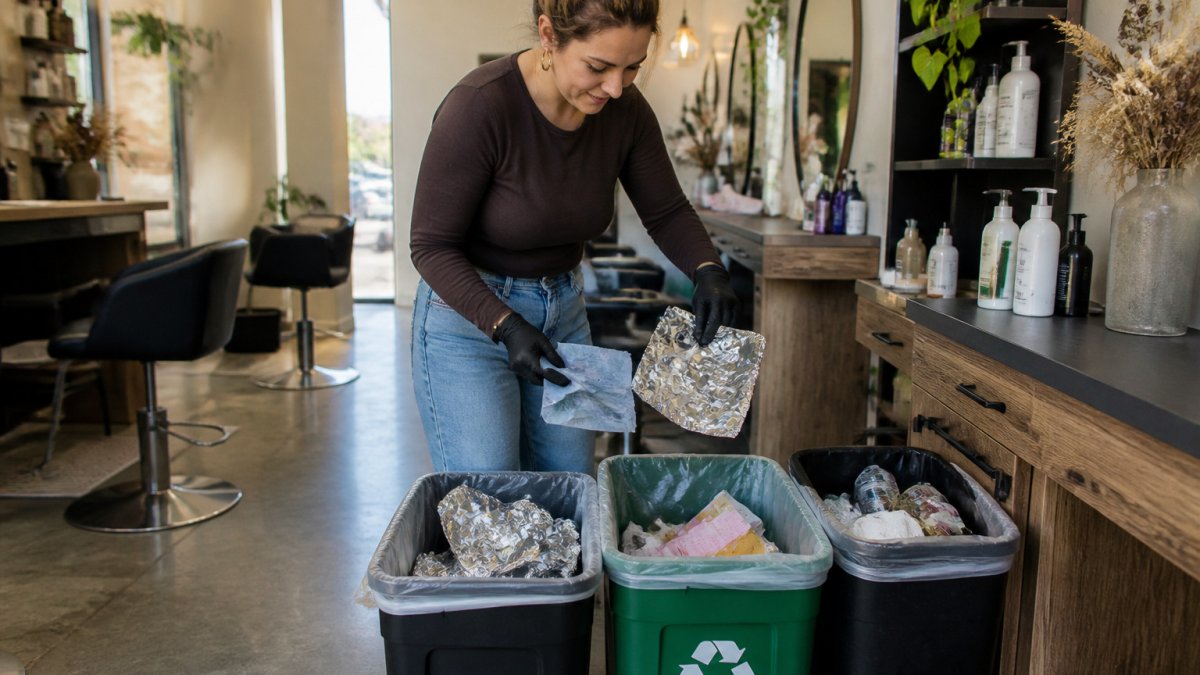
Ask whether the salon uses reusable towels with an efficient laundry cycle, or disposable towels and why. For foils, ask whether they are recycled through a specialist program or sent to landfill. For single-use items like gloves, applicator bottles, and color bowls, ask whether the salon has a refill or reuse system.
Chemical disposal and recycling
Ask how the salon disposes of excess color, developer, and aerosol cans. A credible salon names a hazardous-waste pickup or a specialist recycling program. A weak salon says it "follows the rules" without naming the rule or the handler.
Refill and packaging systems
Ask whether the salon buys in bulk, uses refill systems, or returns packaging to the supplier. Retail shelves are a separate question: a salon that sells refillable retail bottles is reducing plastic, while one that sells only single-use packaging is not.
Staff training and measurement
Operations only work if staff are trained. Ask whether the salon trains employees on waste sorting, water saving, and chemical handling, and whether it tracks results. A salon that measures waste diversion, water use, or energy use can show you a number. One that does not measure cannot improve, and its claims are harder to trust.
Here's a simple way to think about it: products tell you what goes on a client's hair, while operations tell you what happens to everything else.
Booking a Salon Whose Claims You Can Verify
Once you've worked through the steps, you can choose a salon with confidence.
Sunbeam Hair Studio is a member of the Colorado Green Business Network and a Green Circle Salon partner.
Use the checklist from Step 1 and the questions from Step 3 on any salon you're considering.
Frequently Asked Questions
What is greenwashing in a salon?
Greenwashing in a salon is when a business makes environmental claims that it cannot back up with evidence. Examples include using leafy imagery to suggest sustainability or highlighting one clean product while a business's wider operations go unmentioned. The problem is usually not a single false statement but a pattern of claims that are vague, unverifiable, or selectively presented. A genuinely sustainable salon can name its specific practices, explain how it measures them, and point to third-party verification.
How can you tell if a salon's sustainability claims are genuine?
Start by asking what the claim means and how it is measured. Genuine claims are specific, such as a stated waste diversion rate, a named certification, or a listed product ingredient policy. Check whether the salon can point to a third-party program and whether that program's standards are publicly available. Be cautious of claims that rely only on words like 'green,' 'clean,' or 'natural' without supporting detail. You can ask a salon to explain its claims and trade-offs rather than relying only on marketing language.
What questions should you ask a salon about sustainability?
Ask which specific practices the salon uses, such as how it handles color waste, foil recycling, and water use. Ask which certification it holds and what that certification requires. Ask whether its products are chosen for specific ingredients or packaging traits, and whether it can share how waste is tracked. Ask how stylists are trained on sustainable practices. These questions can help you assess the information a salon provides.
Does a salon sustainability certification guarantee a salon is environmentally responsible?
Review what the program covers and whether it is third-party verified. Use the certification as one piece of evidence alongside the salon's specific claims.